Most Pokemon cards gain value because they are rare or because they win games. The Magikarp Illustration Rare from Paldea Evolved did it on art alone, and collectors still point to it whenever they argue that the picture matters more than the rarity stamp. It is, by a wide margin, the best argument that a binder is a place to display art and not just store value.
The art
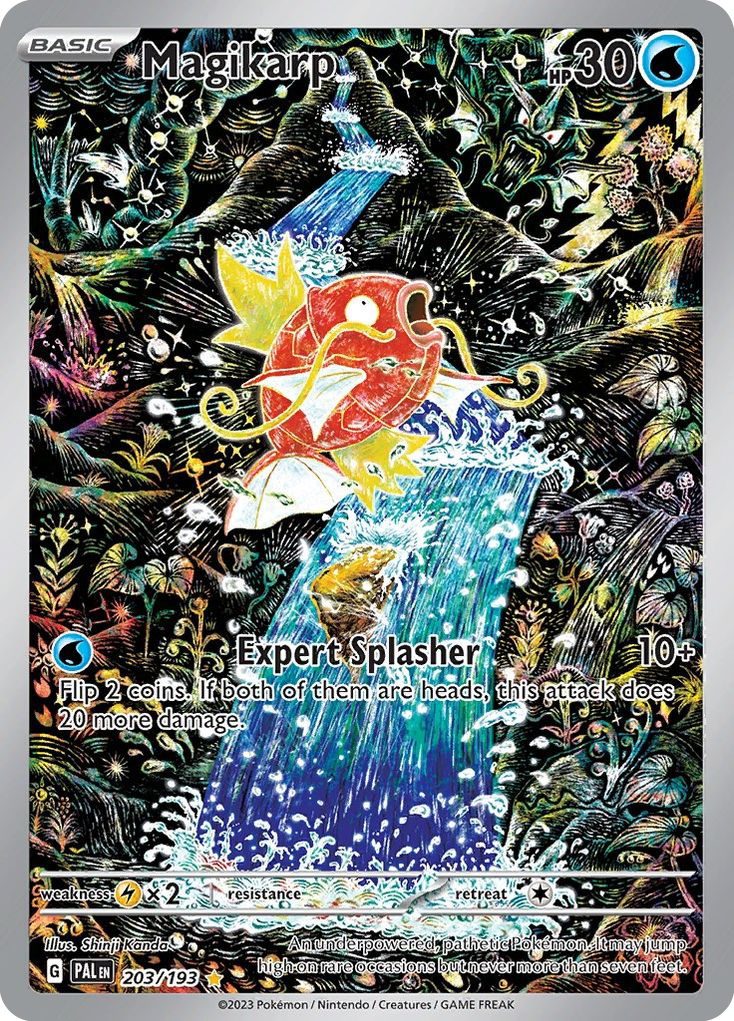
Shinji Kanda illustrated this Magikarp. It is card 203 out of a 193 card set, which means it sits in the secret slot above the main set as an Illustration Rare, a full bleed illustration with no text box crowding the scene. Kanda reimagines the Magikarp to Gyarados arc as the old legend of the Dragon's Gate, a carp fighting upstream through a churning waterfall in the hope of becoming a dragon. The linework is scratchy, hand drawn, and packed with tiny detail, far closer to an ink woodblock print or an indie zine than the clean digital house style almost every other modern card shares. Muted earthy blues and greens fill the border while a warm glow lands on Magikarp itself, so your eye catches the fish first and then wanders the dense surroundings for a while.
That is the whole trick. In a binder full of glossy, evenly lit cards, this one looks hand made, and people stop turning pages when they reach it. Kanda has become a name collectors watch for, which keeps the card in the conversation long after its set left shelves.
Why it is trending
At release this Magikarp was close to bulk. As of June 2026 the holofoil sits around 425 dollars market on TCGPlayer, and it is routinely named as the card that reset what an Illustration Rare can be worth. The driver is not playability, since Magikarp does almost nothing in a match, and it is not rarity in the usual chase sense. It is the art, full stop.
Be honest about what that means. A good chunk of the price now is reputation, the card is famous for being famous, so treat any art first card as something you buy because you want to look at it, not as an investment that owes you a return. If you do want it, that is the healthiest reason to chase a card. For more on planning a collection around cards you love rather than cards you are told to flip, see our guide to organizing a Pokemon binder.
Build a binder page around it
This is where Binder Builders earns its keep. A card this busy and dark wants room to breathe, so feature it in a single pocket page on its own, or set it in the center of a nine pocket page and surround it with calmer cards so the detail reads instead of fighting its neighbors. The palette is earthy blue green with a warm core, which means it pairs naturally with other water and nature art.
In the builder you can search by color to pull blues and greens, drop them around the Magikarp, and press auto arrange to settle the whole page into a gradient. If you collect by illustrator instead, this card also belongs on a creator page next to art from someone like Yuu Nishida, whose work makes an equally strong artist binder.
The Magikarp Illustration Rare is the clearest proof that in the modern TCG the picture can be the entire point. Design the page first, then decide whether you want the real card to anchor it.